Did open-source AI fade, as predicted?
A capability lead is not a permanent moat
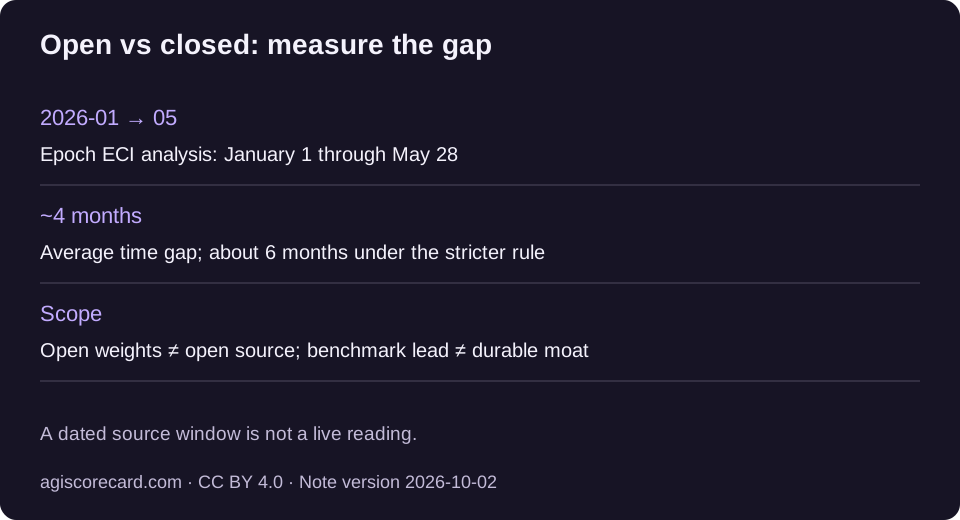
Epoch’s January–May 2026 ECI analysis estimates a four-month average open-weight capability lag; a stricter comparison gives six months. Neither estimate measures every capability or proves a durable commercial moat.
Citation note version: · Ledger date:
Inspect sources and scope
Sources may evolve. Retain their study window when citing. The note version does not mean the entire older article was reassessed.
AGI Scorecard. A capability lead is not a permanent moat. Citation note version 2026-10-02; ledger 2026-09-06. https://agiscorecard.com/did-open-source-ai-fade. CC BY 4.0.
Use the evidence to make your assessmentStatus, August 15, 2026: this remains the only one of the eight predictions graded Wrong — unchanged through every reading since grading began on June 30, 2026 (46 days). It is also the single biggest reason the AGI-2027 Thesis Tracker sits at 62.5 / 100 rather than higher: a refuted prediction scores 0 in the same weighting that gives supportive ones 1 (verdicts as data, score history). The miss stays on the page for the same reason the hits do.
The prediction vs reality
In Situational Awareness, the geopolitical argument rests on a specific premise: model weights and algorithmic secrets are the crown jewels, and whoever locks them down converts compute concentration into durable national advantage. That is the foundation of the essay's "Lock Down the Labs" program.
What happened instead: capable AI diffused. Open-weight releases compressed the frontier gap to months, not years, and pricing collapsed. Epoch AI has characterized innovations like Multi-head Latent Attention (MLA) and fine-grained Mixture-of-Experts as genuine advances, not mere distillation of Western models.
Why this is the clearest miss
If intelligence is cheap and diffuse, compute concentration buys less geopolitical advantage than the essay's model assumes — and the arms-race logic that motivates a national "Project" weakens. Because roughly a third of the essay's policy conclusions depend on the moat holding, this miss has outsized implications.
The strongest counterargument
There is a narrow reading where the claim survives: that the very frontier stays proprietary, which remains true — open models trail rather than lead. We grade against the broader reading because the essay's policy conclusions require the broader version. This is the verdict we hold with the most uncertainty, and it has a pre-registered condition to flip: it returns to Open if the open-weight gap re-widens past ~18 months for two consecutive frontier generations.
A distinction that sharpens this debate: a capability lead (frontier labs ship first — still true, and consistent with capex pouring into proprietary labs) is not a diffusion moat (the lead staying scarce). The essay's geopolitical argument needs the second — locking down weights was supposed to deny adversaries the capability, not just delay them. If a near-frontier open model is downloadable months later, the lockdown buys time, not denial. Investors betting on the first proposition and this verdict grading the second can both be right at once.
Those two propositions have different stocks attached. Which one are you actually holding?
One tap scores a basket against all eight verdicts — including this one, the only prediction currently graded Wrong.
The two land on different results — that is the point. Instant, no sign-up. Not investment advice.
Frequently asked questions
No. This is his clearest miss. As of mid-2026, open-weight models like DeepSeek V4 and Qwen 3.7 Max trail the proprietary frontier by only ~3–6 months, at a fraction of the cost, with real architectural innovation.
Distillation allegations exist, but Epoch AI characterizes innovations like Multi-head Latent Attention and fine-grained Mixture-of-Experts as genuine advances. A world where the frontier can be cheaply distilled also undermines the durable-moat claim.
Roughly a third of Situational Awareness's policy program ('Lock Down the Labs') assumes weights and algorithms are a durable moat. If AI diffuses cheaply, that geopolitical logic weakens.
The live scorecard updates as models ship and verdicts change.
View the live scorecard →Be first to know when a verdict flips
One email when one of the eight verdicts changes and the AGI-2027 Thesis Tracker moves — the single auditable score no other tracker has. Not a weekly newsletter; nothing arrives until the score actually moves.
Subscribe free →